
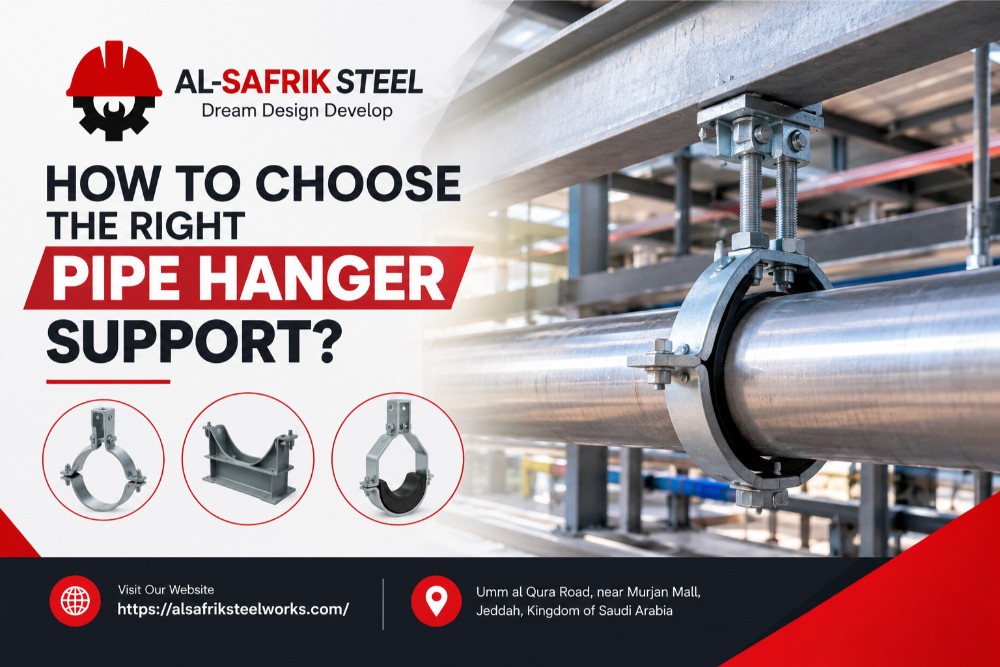
Selecting the right pipe hanger support is an important part of any industrial piping project. A hanger does much more than hold a pipe in place. It carries the pipe’s weight, controls movement, maintains alignment, reduces stress on connected equipment, and supports safe long-term operation.
In Saudi Arabia, piping systems often face demanding industrial conditions, including high temperatures, large temperature changes, heavy mechanical loads, vibration, and challenging installation environments. For projects in Riyadh, Jeddah, Dammam, Jubail, Yanbu, and other industrial areas, select the support system based on pipe size, material, operating conditions, and project requirements.
In this guide, we explain the main factors to consider when choosing a suitable Pipe Hanger Support, while also covering key pipe hanger types, and industrial pipe supports used in modern construction and industrial applications.
Importance of Right Pipe Hanger Support
A piping system can contain significant amounts of fluid, insulation, valves, fittings, and other components. All of these create loads that must be transferred safely to the building structure or supporting framework. A properly selected pipe hanger support distributes these loads and helps prevent excessive movement or deformation.
When the pipe hanger support is wrong, stress moves into flanges, valves, and pumps. Leaks follow, and repairs cost money. In oil, gas, power, and petrochemical plants, an unplanned shutdown costs far more than the hanger ever did. Saudi Arabia adds its own pressure. Summer temperatures in Riyadh and Dammam often pass 45°C, and that heat makes pipes expand more than many designers expect. Good support is a small part of the budget, but it decides how long the whole system lasts.
Things To Consider While Choosing the Right Pipe Hanger Support
Understand the Pipe Before Choosing a Support:
First, understand the piping system itself. No single hanger design suits every application. The support must match the pipe’s physical and operating characteristics.
Before selecting a pipe hanger support, consider:
- Pipe diameter and wall thickness
- Pipe material
- Empty and operating pipe weight
- Fluid density
- Insulation thickness and weight
- Operating temperature
- Pressure conditions
- Thermal expansion
- Vibration
- Corrosion exposure
- Required support spacing
- Available structural attachment points
For example, a small utility line may require a relatively simple pipe clamp support, while a large industrial pipeline may require engineered structural components capable of handling substantial loads.
Consider the Total Pipe Load:
Weight is one of the most important factors in selecting a pipe hanger support. Engineers should not consider only the weight of the empty pipe. The complete operating load may include the pipe itself, fluid, insulation, valves, fittings, flanges, and other attached components.
The support must be capable of carrying the expected load without excessive deformation. Where heavy valves or equipment are installed, additional supports may be required to prevent concentrated loads from being transferred to weaker sections of the piping system.
A practical load assessment can include:
- Empty pipe weight
- Operating fluid weight
- Insulation and cladding
- Fittings and flanges
- Valves and specialty components
- Temporary or maintenance-related loads
This approach helps establish an appropriate pipe support system instead of relying on a standard component without considering the actual application.
Select the Correct Hanger Type:
Different applications require different types of pipe hanger support. The choice depends on the pipe’s movement, load, installation method, and operating conditions.
Common options include:
Clevis Hangers:
They are widely used for suspended piping. They typically support the pipe from below on a threaded rod or similar vertical arrangement. They suit many commercial and industrial applications that require vertical suspension.
Split Ring Hangers:
Designed to provide a practical way to support smaller pipes. They are often selected for utility and mechanical piping where the loads and movement requirements are relatively moderate.
Pipe Clamps:
A pipe clamp surrounds or grips the pipe and transfers its load to the supporting structure. Different clamp configurations are available for insulated and uninsulated piping.
Roller Supports:
Roller arrangements allow controlled horizontal movement. They can be useful where thermal expansion causes the pipe to move along its axis.
Spring Hangers:
They are used where vertical movement must be accommodated. They can provide controlled support when a piping system experiences significant thermal expansion or contraction.
Rigid Hangers:
Rigid arrangements restrict unwanted movement while carrying vertical loads. They are useful where the piping design requires firm positioning rather than free movement.
Therefore, select the correct pipe hanger support based on actual movement and loading requirements, rather than simply choosing the most commonly available hanger.
Account for Thermal Expansion:
Temperature changes can cause pipes to expand and contract. This is particularly important in industrial facilities where piping may carry hot fluids, steam, process chemicals, or other materials at elevated temperatures. A support that completely restricts movement where movement is required can increase stress within the piping system. On the other hand, allowing too much uncontrolled movement can affect alignment and connected equipment. A suitable thermal pipe hanger support should therefore work with the overall piping design. Engineers may use guides, anchors, sliding supports, or spring arrangements to control movement while allowing expansion in the intended direction.
This consideration is especially relevant to industrial projects in Saudi Arabia, where high ambient temperatures can add another environmental factor to equipment and piping design.
Check the Supporting Structure:
A hanger can perform properly only if the supporting structure can handle the imposed load. This means the selection process should not stop at the pipe. The structural attachment may be a steel beam, concrete structure, pipe rack, equipment frame, or another engineered support arrangement. Evaluate its capacity and condition before installation.
Important considerations include:
- Structural load capacity
- Attachment method
- Beam or frame dimensions
- Anchor requirements
- Installation access
- Corrosion protection
- Required clearances
This is why industrial pipe hanger supports are often considered as part of a larger engineering system rather than as isolated components.
Choose Suitable Materials and Finishes:
Material selection is another important consideration, especially for projects in Saudi Arabia. The support material should be appropriate for the environment in which it will be installed. Carbon steel supports are widely used for many industrial applications because they offer strength and durability. Depending on the environment, galvanized, coated, or stainless-steel components may be considered to provide additional corrosion resistance.
For coastal and humid locations such as Jeddah, Dammam, and parts of the Eastern Province, corrosion protection deserves particular attention. Industrial environments may also expose supports to chemicals, moisture, dust, and other contaminants.
Therefore, select the correct pipe hanger support with both mechanical performance and environmental exposure in mind.
Do Not Ignore Pipe Insulation:
Insulated pipes require special attention because the support arrangement should not unnecessarily damage the insulation system. A support may need to accommodate insulation thickness, protective shields, or inserts. If the support compresses the insulation too much, it may create thermal bridges or damage the insulation jacket.
For chilled-water systems, steam lines, and temperature-sensitive applications, this issue can be particularly important. Proper insulated pipe supports help maintain insulation integrity while carrying the required load. Therefore, check hanger dimensions against the actual pipe and insulation configuration before fabrication or installation.
Follow Project and Engineering Requirements:
Every major industrial project can have its own specifications. These may define acceptable materials, dimensions, coatings, welding requirements, inspection procedures, load ratings, and installation methods. Saudi projects may also involve requirements from project owners, consultants, engineering contractors, or applicable standards. Review the support design against the relevant project documentation before procurement.
This is especially important for oil and gas facilities, petrochemical plants, power plants, water-treatment facilities, and large commercial developments. Do not select a heavy-duty pipe hanger support merely because it appears stronger. Verify its dimensions, connection method, load rating, and compatibility with the piping system.
Evaluate Installation and Maintenance Requirements:
A technically suitable support can still create practical problems if it is difficult to install or maintain. Installation teams need sufficient access to attach the support correctly and inspect it later. Maintenance personnel should also be able to reach valves, joints, insulation, and other components without unnecessary interference from support members.
During planning, consider:
- Installation access
- Required tools
- Inspection points
- Adjustment requirements
- Replacement access
- Clearance from nearby equipment
- Future maintenance activities
A well-planned pipe suspension system should support the pipe while fitting naturally into the overall facility layout.
Avoid Common Pipe Support Mistakes
Many support problems occur because designers and installers overlook basic considerations during design or installation. Understanding these common mistakes can help project teams prevent unnecessary corrective work.
Using One Design Everywhere:
Pipe sizes and operating conditions vary. A hanger suitable for one line may not suit another.
Ignoring Operating Weight:
Using empty-pipe weight instead of operating weight can result in an inadequate support arrangement.
Restricting Thermal Movement:
Installing rigid supports where movement is required can create unwanted stresses.
Poor Structural Attachment:
Even a high-quality hanger can fail to perform if its attachment to the structure is inadequate.
Neglecting Corrosion:
Unprotected components may deteriorate faster in aggressive environments.
Compressing Insulation:
Improper support arrangements can damage insulation and reduce system efficiency.
Avoiding these mistakes improves the reliability of the complete pipe hanger support arrangement.
Work With the Right Steel Support Partner:
The quality of the right pipe hanger support system depends on both the design and the components used to manufacture it. A supplier with the right fabrication capabilities can help ensure steel components meet project requirements.
Al Safrik Steel serves industrial and construction requirements with steel fabrication solutions and can be referenced when evaluating support components for projects across Saudi Arabia.
From large industrial developments to infrastructure and mechanical installations, the objective should always be the same: provide a reliable supporting arrangement that matches the piping system and its operating environment.
Final Thoughts
Choosing the right pipe hanger support requires more than selecting a standard hanger from a catalog. The decision should consider pipe size, operating weight, temperature, thermal movement, vibration, insulation, corrosion exposure, structural capacity, and project specifications.
The right support maintains pipe alignment, manages loads, controls movement, and supports the installation’s long-term reliability. For projects in Saudi Arabia, consider location-specific conditions when selecting materials and finishes.
Whether the project is located in Riyadh, Jeddah, Dammam, Jubail, Yanbu, or another industrial area, careful support selection can reduce installation problems and support safer, more dependable piping systems.
Frequently Asked Questions
What is a Pipe Hanger Support?
A pipe hanger support is a component or assembly used to suspend and support piping from a structural member while controlling its position and movement.
How do I select a pipe hanger?
Consider pipe size, operating weight, temperature, insulation, movement, vibration, corrosion exposure, and the supporting structure’s capacity.
What are common pipe hanger support types?
Common types include clevis hangers, split-ring hangers, pipe clamps, rigid hangers, roller supports, and spring hangers.
Are pipe supports important for industrial projects?
Yes. Properly designed supports help carry pipe loads, control movement, maintain alignment, and reduce stress on piping and connected equipment.
Where are pipe supports used in Saudi Arabia?
They are used across industrial, commercial, infrastructure, oil and gas, petrochemical, power, water-treatment, and construction projects throughout Saudi Arabia.

Recent Comments