
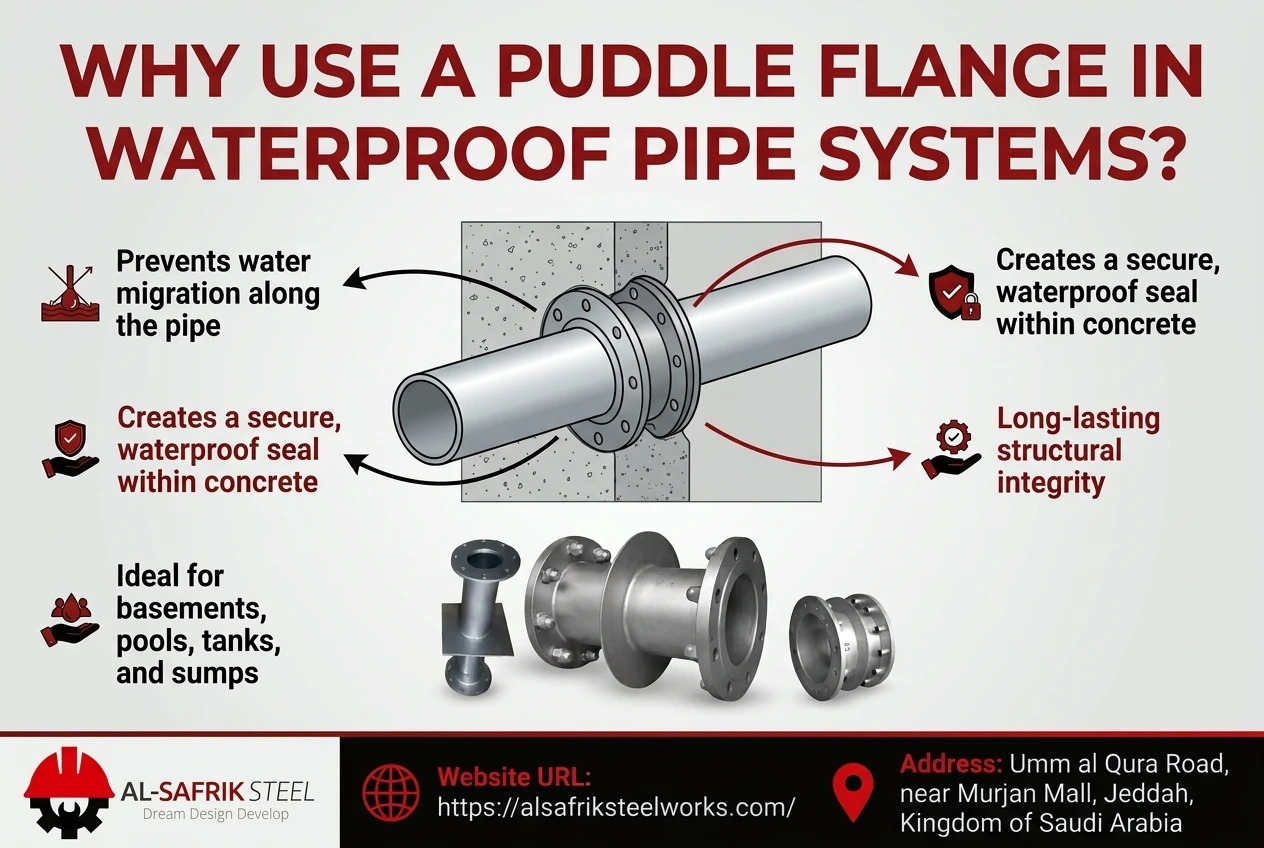
Water leakage around pipe penetrations is a common concern in concrete structures. Pipes often pass through walls, floors, tanks, basements, chambers, and other water-retaining structures. Even when the concrete itself is properly constructed, the small gap or interface around a pipe can become a path for water movement.
A puddle flange addresses this specific weakness. It creates a barrier around a pipe penetration and helps prevent water from traveling along the outside of the pipe and through the concrete. Depending on the design, the component may be welded or attached around the pipe before the concrete is poured, allowing the flange or collar to embed in the structure.
For construction projects in Saudi Arabia, effective pipe penetration sealing is particularly important in underground structures, water tanks, wastewater facilities, pumping stations, and other infrastructure exposed to moisture or groundwater.
Key Benefits of Using a Puddle Flange
A properly specified puddle flange offers several practical benefits for concrete and piping systems. Its value comes from addressing the pipe-to-concrete interface before leakage becomes a maintenance problem.
-
Helps Prevent Water Seepage:
The primary purpose is to interrupt water movement around the pipe. The flange embeds in the concrete and blocks seepage along the pipe’s external surface. This is especially useful where concrete structures are exposed to groundwater or need to retain water.
-
Supports Watertight Construction:
A watertight pipe penetration requires more than simply filling the gap around a pipe. A dedicated water-stop element can form part of the overall waterproofing system. When correctly installed, it helps make the pipe entry more resistant to water migration.
-
Suitable for Underground Structures:
Below-ground construction can face continuous moisture exposure and hydrostatic pressure. Basements, tanks, chambers, and underground utility structures therefore require careful penetration treatment. A properly designed water-stop collar can help protect these areas from leakage.
-
Provides a Long-Term Embedded Barrier:
Unlike a temporary surface repair, an embedded component becomes part of the concrete structure. This means the waterproofing barrier is positioned at the penetration during construction rather than being added only after a leakage problem develops.
-
Can Be Customized:
Projects rarely have identical pipe diameters, wall thicknesses, materials, and installation conditions. Manufacturers can fabricate solutions to match approved drawings and project requirements.
Custom dimensions may include pipe diameter, plate diameter, thickness, length, position, and material.
Where Are Puddle Flanges Commonly Used?
A puddle flange is a metal collar fixed around a pipe where it crosses a concrete structure. It is usually a flat steel ring welded to the pipe at right angles. When the concrete is poured, the ring sits inside it, normally at the middle of the wall or slab thickness.
You may also hear it called a puddle pipe, a water-stop collar, or a wall collar. The names vary by region and supplier, but the purpose is the same: to block the path water would otherwise take along the outside of the pipe.
The pipe section is usually a short spool or sleeve, fabricated with the ring already welded on. It is set in the formwork before the concrete is placed. After curing, the pipe becomes a fixed part of the structure, and the ring is locked inside it.
The Problem: Water Travels Along the Pipe:
To see why this collar matters, it helps to understand how leaks form at pipe penetrations. Concrete shrinks slightly as it cures, while steel does not behave in the same way. The result is a very thin gap, or at least a weak bond, along the pipe’s outer surface. Temperature changes, vibration, and small structural movements can widen that gap over time.
Pressurized water will use any gap it can find. In a basement wall, groundwater creates the pressure. In a tank, it comes from the stored liquid. Once water enters the gap on the wet side, it can creep along the pipe surface until it appears on the dry side. Engineers call this a leakage path, and it commonly causes failure in poorly detailed penetrations.
Sealants and wraps applied after construction can help, but they depend on surface preparation and quality, and they degrade over time. A better approach is to build the protection into the structure from the start.
How a Puddle Flange Stops Leakage?
The ring protects the penetration in three ways.
It lengthens the leakage path:
The ring projects outward from the pipe. Water traveling along the pipe surface meets this projection and has to detour around it, following the contact surface between steel and concrete. That extra distance adds resistance, so the pressure driving the water drops and the chance of it reaching the dry side falls sharply.
It grips the concrete:
Concrete sets around the ring and holds it firmly. The flat face gives a large bearing surface, and any water trying to pass must cross this tight contact zone. Because the ring is embedded rather than fixed on afterward, it stays put for the life of the structure.
It anchors the pipe:
The ring also holds the pipe in position. It resists pull-out forces, vibration, and loads from the connected pipework. A pipe that stays firmly fixed is less likely to open a gap in the first place.
Moreover, these applications are found across major Saudi cities and industrial areas, including Riyadh, Jeddah, Dammam, Jubail, Khobar, and Yanbu, depending on the project’s infrastructure requirements.
Installation Requires Careful Coordination:
A puddle flange’s performance depends heavily on installation quality. Even a well-manufactured component can fail to provide the intended protection if it is positioned incorrectly or the concrete is poorly compacted. Before installation, contractors should verify:
- Pipe outside diameter
- Wall or slab thickness
- Flange position
- Plate diameter and thickness
- Required concrete cover
- Welding or joining requirements
- Coating requirements
- Pipe alignment
- Approved drawings
- Waterproofing details
For steel fabrication, continuous and properly executed welding between the pipe and water-stop plate is important. Concrete should also be thoroughly compacted around the embedded component to avoid voids. Coordination between civil, structural, MEP, and waterproofing teams can prevent costly changes during construction.
Common Mistakes to Avoid:
Poor penetration detailing can undermine an otherwise effective waterproofing system. Common mistakes include selecting dimensions without checking wall thickness, positioning the flange incorrectly, and ignoring the surrounding waterproofing system. Other problems include:
- Using an unsuitable material for the environment
- Failing to follow approved drawings
- Leaving voids during concrete placement
- Incorrect pipe alignment
- Poor welding or joining
- Applying unsuitable coatings
- Ignoring groundwater conditions
- Treating the flange as a substitute for complete waterproofing
A water-stop component is one part of a larger construction system. It should work together with concrete design, joint treatment, membranes, sealants, drainage, and other approved waterproofing measures where required.
Why Quality Matters in Water-Stop Components?
The cost of a penetration component is usually small compared with the potential cost of repairing concealed leakage after construction. Water entering a basement, tank, chamber, or underground structure may require investigation, breaking concrete, removing finishes, resealing the penetration, and restoring the affected area.
Using an appropriately designed puddle flange during the original construction can help reduce the likelihood of these problems. Quality involves more than material grade. It includes accurate dimensions, appropriate welding, correct positioning, suitable surface protection, and compliance with project drawings.
A good procurement process should therefore consider the complete product specification instead of comparing suppliers only on unit price.
Puddle Flange: A Practical Approach for Saudi Construction Projects:
For contractors and project managers, selecting a puddle flange should begin with the project drawings rather than the product catalog. Start by identifying every pipe penetration through waterproofed or water-retaining structures. Record pipe sizes, materials, wall thicknesses, locations, and environmental conditions.
Then confirm the required sealing method with the structural and MEP teams. The supplier can use these details to develop or supply a suitable component. For larger infrastructure projects, documentation is equally important. Depending on the project specification, you may need material certificates, fabrication details, dimensions, inspection records, and coating information. This structured approach can reduce installation delays and prevent costly later modifications.
Selecting a Reliable Supplier in Saudi Arabia:
When sourcing a puddle flange, buyers should look beyond basic product availability. The supplier should understand fabrication requirements and be able to work from project drawings, specifications, and pipe dimensions. For Saudi projects, useful supplier considerations include:
- Manufacturing capability
- Material traceability
- Dimensional accuracy
- Welding quality
- Custom fabrication
- Protective coating options
- Technical documentation
- Project-specific support
- Delivery requirements
- Experience with industrial applications
Consider Al Safrik Steel when your project requires fabricated steel components and customized solutions. For projects in Saudi Arabia, clear communication of pipe sizes, materials, wall thicknesses, drawings, quantities, and coating requirements can help suppliers prepare an accurate quotation. We understand all these factors and deliver the product accordingly. From pipe rigging rollers to pipe spools, we have everything that you need to enhance production.
Whether the project is in Riyadh, Jeddah, Dammam, Jubail, or another Saudi location, finalize the specification based on the project’s engineering requirements.
Final Thoughts
A puddle flange offers a practical way to address one of the most vulnerable areas in waterproof concrete construction: pipe penetrations. By creating a barrier around the pipe and embedding it within the concrete, the system can help restrict water movement along the pipe-concrete interface.
Its applications range from water tanks and treatment plants to basements, pumping stations, reservoirs, underground chambers, and industrial infrastructure. Select the material, dimensions, configuration, and installation based on the specific project conditions.
For Saudi Arabia’s demanding construction environment, careful planning is essential. Projects in Riyadh, Jeddah, Dammam, Jubail, Yanbu, and other areas can benefit from properly coordinated pipe penetration details where groundwater, water retention, or moisture exposure is a concern. Al Safrik Steel can support project requirements involving fabricated steel solutions, subject to the approved drawings and technical specifications. The best results come from treating waterproofing as a complete system, with the pipe penetration, concrete, joints, coatings, and drainage details working together.
Frequently Asked Questions
What is the main purpose of a puddle flange?
It helps prevent water from traveling along the outside of a pipe where it passes through a concrete structure.
Where is a puddle flange commonly installed?
Commonly used in tanks, basements, reservoirs, treatment plants, pump stations, chambers, and other water-exposed structures.
Can puddle flanges be customized?
Of course. We can fabricate versions to match pipe dimensions, wall thickness, material, plate size, and approved project drawings.
What materials can be used?
Depending on the application, options may include carbon steel, stainless steel, PVC, uPVC, and HDPE. Material compatibility must be confirmed for the specific project.
Does a puddle flange replace all waterproofing?
It addresses the pipe penetration and should be coordinated with the project’s complete waterproofing and structural system.

Recent Comments