
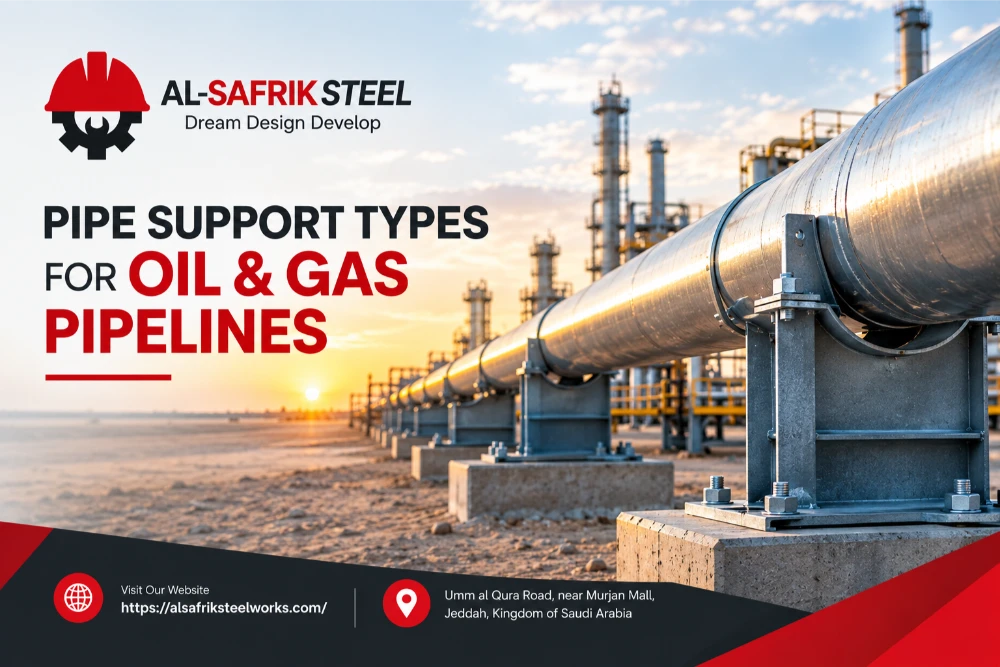
The giant industry of oil and gas pipelines carries heavy loads across long distances, often through extreme desert heat and shifting terrain. A pipeline is only as strong as the structure holding it in place. Understanding the different pipe support types used across Saudi Arabia’s energy corridors, from Dammam to Jubail, helps engineers, contractors, and plant owners plan safer and longer-lasting pipeline systems. Through this guide, we will walk through the main categories of pipe supports, how each one works, and how to choose the right support for a given project. As a leading steel fabrication company, Al Safrik Steel has supplied structural steel and pipe support components across Saudi Arabia for years.
Why Pipe Supports Matter in Oil and Gas Pipelines?
A pipeline network in the oil and gas sector rarely runs in a straight, unsupported line. It crosses pipe racks, bridges, tank farms, and long stretches of open desert. Without proper pipeline support systems, the pipe would sag under its own weight, and the joints and welds would come under constant stress. Over time, this stress leads to fatigue cracks, leaks, and costly shutdowns.
A well-designed support structure does four jobs at once, including:
- It carries the dead weight of the pipe and the fluid inside it.
- Controls movement due to thermal expansion and contraction.
- It absorbs vibration from pumps, compressors, and flow surges.
- Keeps the pipe aligned so that connected equipment does not incur additional strain.
In Saudi Arabia, where daytime temperatures can exceed 45 degrees Celsius, thermal expansion is a critical design consideration, and the choice of industrial pipe support types directly impacts pipeline safety.
Main Categories of Pipe Support Types
Engineers group pipe supports into a few broad families based on the job each one performs. Some hold the pipe from above, some rest it from below, and others allow it to move slightly while keeping it in place. Below is a breakdown of the most common types of pipe supports used in oil and gas construction.
1. Hanger Supports:
They hold the pipe from an overhead structure using a rod, chain, or spring assembly. They are common on pipe racks and inside process units where the pipe runs below a beam or platform. There are three main variations.
- Rigid hangers: Use a solid rod to hold the pipe in a fixed vertical position. Best suited for lines with little or no thermal movement.
- Variable spring hangers: Use a calibrated spring so the support load changes slightly as the pipe moves up or down with temperature changes.
- Constant load hangers: Deliver the same supporting force throughout the full range of pipe movement, which protects sensitive connections at pumps and turbines.
2. Resting and Bearing Supports:
Resting supports sit beneath the pipe and carry its weight without fully restraining it. These are the most widely used pipe support types on horizontal pipe racks because they are simple to install and easy to inspect.
- Pipe shoes: Steel plates welded to the underside of the pipe, allowing it to slide across the support structure as it expands or contracts.
- Pipe saddles: Curved steel cradles that spread the load over a wider area, often used with insulated lines.
- Trunnion supports: A short length of pipe welded at a right angle to the main line, resting on a secondary support below. Common on elbows and vertical-to-horizontal transitions.
- Wear pads: Thin metal plates installed between the pipe and its support to reduce friction-induced damage during sliding.
3. Guides and Sliding Supports:
These supports keep a pipe aligned along its intended path while still permitting it to move lengthwise as it heats and cools. They stop the pipe from drifting sideways off the rack, which matters most on long straight runs found in cross-country pipelines and refinery piping between units. Sliding supports work alongside guides, using low-friction plates made of Teflon, stainless steel, or graphite so the pipe can travel smoothly without binding.
4. Anchor Supports:
They are the opposite of guide supports and lock the pipe completely at a single point, preventing all movement in any direction. Anchors are placed at strategic locations, such as near a branch connection or at the start of a long expansion loop, so that thermal movement is directed away from sensitive equipment. Every pipeline design needs a mix of anchors and guides working together, since anchoring the whole line would trap thermal stress with nowhere to go.
5. Spring Supports:
These supports absorb the vertical movement that happens when a hot pipeline expands and lifts slightly off its resting point. They are installed at locations where the pipe needs to move up and down without losing contact with the support. This category overlaps with hanger supports but also includes base-mounted spring units used under vertical risers and equipment nozzles.
6. Dynamic and Restraint Supports:
It is one of the pipe support types that protect the system from sudden forces rather than steady loads. These forces can come from a water-hammer event, a relief-valve discharge, or seismic activity.
- Struts: Rigid braces that resist movement in a specific direction during a sudden load event.
- Snubbers: Hydraulic or mechanical devices that stay passive during slow thermal movement but lock instantly during a fast shock, such as an earthquake.
- Sway braces: Spring-loaded restraints that control vibration on lines connected to rotating equipment like pumps and compressors.
Multiple industries select customized pipe supports for their large projects, and Al Safrik Steel provides the best solutions to meet their needs.
Choosing the Right Pipe Support Types for Saudi Arabian Pipeline Projects
Selecting the correct pipe support type depends on more than pipe diameter. Engineers working on projects around Dammam, Jubail, Yanbu, Dhahran, and Ras Tanura need to account for the local climate and terrain. The extreme heat across the Eastern Province accelerates thermal growth in long steel pipelines, increasing the demand for properly sized expansion loops and spring hangers. Coastal facilities near the Arabian Gulf also face high humidity and salt-laden air, which accelerate corrosion of unprotected steel supports.
Sand and dust are another factor unique to the region. Sliding supports installed in exposed desert areas require regular cleaning and lubrication, as blown sand can accumulate on bearing plates and cause the pipe to bind rather than slide freely. Project teams sourcing from a structural steel supplier in Saudi Arabia should confirm that support components are rated for the site’s specific temperature range, wind loading, and soil conditions.
A few practical points to weigh during the design phase:
- Pipe size and wall thickness, which determine the base weight the support must carry.
- Operating temperature, since hot lines need more allowance for expansion than cold or ambient lines.
- Insulation, which adds weight and often requires a wider saddle or shoe.
- Span length between supports, which should stay short enough to avoid excess sagging.
- Seismic and wind exposure at the site, which may call for additional dynamic restraints.
Material Selection and Corrosion Resistance
The most commonly used pipe support types in the oil and gas industry are made of carbon steel, though stainless steel is used in coastal or highly corrosive settings. A protective coating, such as hot-dip galvanizing or epoxy paint, extends the support’s working life and reduces maintenance costs over time. Given the harsh outdoor conditions common across Saudi industrial zones, choosing supports with the right coating system is just as important as choosing the correct support type.
Why Work with Al Safrik Steel?
Our well-known company manufactures and supplies different steel pipe support types, structural steel fabrications, and lifting equipment for oil, gas, and industrial projects across Saudi Arabia and the wider Gulf region. The team works closely with the engineering, procurement, and construction teams to deliver support components built to project specifications, ranging from simple pipe shoes to custom trunnion assemblies. Choosing a supplier with regional experience matters when a project must withstand the heat, humidity, and sand exposure found in Saudi Arabia’s industrial cities.
Maintenance and Inspection of Pipe Supports
Selecting one of the pipe support types is not a one-time installation. Regular inspection keeps the whole pipeline system safe over its working life. Maintenance teams across Saudi Arabia’s refineries and gas plants typically build support checks into their routine turnaround schedules, since a small problem caught early is far cheaper than an unplanned shutdown.
- Check sliding surfaces for sand buildup, rust, or worn pads that could cause the pipe to bind rather than move freely.
- Inspect spring hangers to confirm the load indicator sits within the designed travel range.
- Look for cracked welds on trunnion supports and dummy legs, since these carry concentrated stress at the branch connection.
- Confirm that guides and anchors have not shifted out of position after a seismic event or heavy equipment movement nearby.
- Recoat exposed steel supports on schedule, particularly at coastal sites where salt air accelerates corrosion.
A documented inspection plan, paired with support components sourced from a reliable industrial steel supplier, gives operators confidence that the pipeline will continue to run safely through years of heat, vibration, and heavy operating loads.
Final Thoughts
Pipe supports may seem like a small part of a pipeline project, but they carry the full weight of the system, both literally and structurally. Choosing the correct pipe support types for each section of the line protects the pipeline from sagging, vibration damage, and thermal stress over its working life. Whether a project calls for hangers, resting supports, guides, anchors, or dynamic restraints, working with an experienced regional supplier like Al Safrik Steel helps ensure that the right components arrive on site on time and are built to last.
Frequently Asked Questions
What is the main purpose of a pipe support in oil and gas pipelines?
A pipe support carries the weight of the pipe and its contents, controls movement due to thermal expansion, and keeps the line aligned with its intended path.
What are the most common pipe support types used on pipe racks?
Resting supports, such as pipe shoes, saddles, and trunnion supports, are the most common because they are simple to install and easy to inspect on horizontal pipe racks.
How does heat affect pipe support selection in Saudi Arabia?
High daytime temperatures across the Eastern Province increase thermal expansion in steel pipelines, so more projects require spring hangers, guides, and properly sized expansion loops.
What is the difference between a guide and an anchor support?
A guide keeps the pipe aligned while allowing it to move lengthwise, whereas an anchor locks the pipe at a single fixed point.
Why does material choice matter for pipe supports in coastal areas?
Coastal humidity and salt exposure accelerate corrosion, so supports near the Arabian Gulf often require stainless steel or a protective coating to last throughout their service life.

Recent Comments