
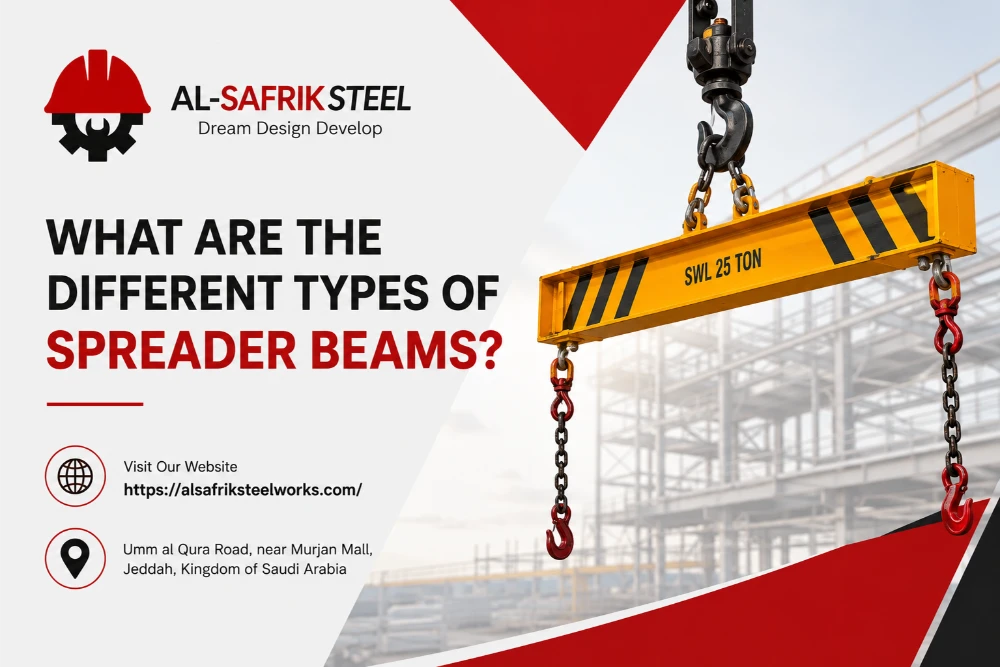
Lifting heavy or oddly shaped loads is never a simple job. Anyone who has worked on a construction site, in a shipyard, or around heavy industrial equipment knows that a single crane hook is rarely enough to lift a load safely. It is exactly where a spreader beam comes into the picture: a lifting device that spreads the load across multiple pick points, reducing stress on the load and keeping it stable during a lift. In Saudi Arabia’s fast-growing construction and industrial sectors, from Riyadh to Jeddah and Dammam, these beams have become a standard part of any serious lifting operation.
At Al Safrik Steel, we are often asked which type of beam is right for a particular job. The honest answer is that it depends on the load, the site conditions, and the lifting method being used.
What Exactly Is a Spreader Beam?
Before jumping into types, it helps to understand what a spreader beam actually does. It is a rigid steel structure, usually a beam or a lattice frame, that has lifting points at both ends. Instead of a crane hook pulling straight down on a single point of a load, the beam distributes that pulling force across two or more attachment points. It is particularly useful for long, wide, or fragile loads such as pipes, steel girders, precast concrete panels, or machinery.
The main purpose of a lifting beam (another common term used interchangeably with lifting beam in some regions) is to keep the sling angles vertical or close to vertical. It reduces horizontal stress on the load and on the rigging equipment, which in turn lowers the risk of the load buckling, tipping, or shifting mid-lift. For companies handling structural steel, pipeline sections, or modular units across Saudi Arabia, this single feature can be the difference between a smooth lift and a costly accident.
Different Types Of Spreader Beams
1. Fixed Spreader Beams:
It is the most traditional and widely recognized type. As the name suggests, this beam has a set, unchangeable length and fixed lifting points. It is manufactured for a specific load width and does not allow on-site adjustment. These beams are popular because they are simple, strong, and require very little setup time. Once the correct beam is selected for the job, the rigging crew attaches it and proceeds with the lift. This type works best in repetitive lifting operations where the load dimensions remain consistent, such as lifting the same-sized precast panels repeatedly on a construction site in Riyadh or Al Khobar.
Key advantages of fixed beams include:
- Straightforward design with fewer moving parts
- High load capacity for their size
- Lower maintenance requirements
- Cost-effective for standardized lifting tasks
The main limitation is flexibility. If your project involves loads of varying sizes, a fixed beam may not be practical unless you have several beams of different lengths on hand.
2. Adjustable Spreader Beams:
For projects where load dimensions change frequently, an adjustable spreader beam is usually the better choice. It is the type that allows the lifting points to be moved along the length of the beam, or in some designs, the beam itself can be extended or shortened using telescopic sections.
Adjustable beams are especially valuable on sites with mixed lifting requirements, such as fabrication yards or industrial plants where different equipment, tanks, or steel sections need to be moved on different days. Instead of stocking multiple fixed beams, a single adjustable unit can handle a wider range of tasks.
These beams are commonly found in modular construction projects, oil and gas facilities, and warehouses across Jeddah, Dammam, and the Eastern Province, where lifting needs can shift from one week to the next. While adjustable beams do involve slightly more setup and inspection time, the long-term flexibility often outweighs that extra effort.
3. Telescopic Spreader Beams:
It is the type of beam that deserves its own mention because it operates a bit differently from a standard adjustable beam. Rather than repositioning fixed lifting points, a telescopic beam extends and retracts like a sliding tube, allowing for a continuous range of lengths rather than a few preset positions.
This design is particularly useful when dealing with:
- Long structural steel members of varying lengths
- Precast concrete beams with irregular dimensions
- Pipeline sections that differ from batch to batch
Because telescopic beams can be adjusted quickly on-site, they save time compared to switching between multiple fixed beams. However, they do require careful inspection of the locking mechanisms before every lift, since the telescopic sections carry the load and must be fully secured.
4. Modular Spreader Beams:
These beams are built from separate sections that can be bolted or pinned together to create different configurations. This type is favored for large-scale projects where lifting requirements are unpredictable or extremely heavy loads need to be distributed across multiple lifting points.
A modular system might combine two or three beam sections end to end, or be arranged in a frame-like structure to support a wide, heavy load, such as a prefabricated steel module or a large piece of process equipment. This flexibility makes modular beams a favorite in the oil, gas, and petrochemical sectors, which are heavily present across Saudi Arabia’s industrial cities.
The trade-off with modular systems is that they require more careful assembly and a competent rigging team to configure them correctly for each specific lift. Improper assembly can compromise the entire lifting operation, so training and experience matter a great deal here.
5. Multi-Point Spreader Beams (Spreader Frames):
Sometimes referred to as a spreader frame, this type is designed for loads that need more than two lifting points. Instead of a single beam, a spreader frame uses a rectangular or grid-like structure with multiple attachment points spread across its surface.
This is the go-to option for lifting:
- Large precast concrete slabs
- Wide steel plates
- Prefabricated building modules
- Heavy machinery with an uneven weight distribution
Spreader frames are particularly important when a load’s center of gravity is not centrally located, since the additional lifting points allow riggers to balance the load precisely. On large infrastructure projects in Makkah, Madinah, or NEOM, where oversized modules are increasingly common, spreader frames have become essential lifting tools.
6. Custom-Engineered Spreader Beams:
Not every load fits into a standard category, and this is where custom-engineered beams come in. These are designed and manufactured to match the exact specifications of a particular load, taking into account its weight, dimensions, center of gravity, and the required rigging configuration.
At Al Safrik Steel, custom spreader and lifting beam solutions are often requested for unusual or one-off lifts, such as moving specialized industrial equipment, unique architectural elements, or non-standard structural components. While custom beams take longer to design and fabricate, they offer the highest degree of safety and precision for complex lifting challenges.
Choosing the Right Spreader Beam for Your Project
Selecting the correct type of beam is not just about matching the length to the load. Several other factors need to be considered:
- Load weight and capacity rating: Always confirm the beam’s safe working load exceeds the load being lifted, with an appropriate safety margin.
- Load dimensions and shape: Long, wide, or irregular loads may require adjustable or modular designs.
- Center of gravity: Loads with an off-center weight distribution often need multi-point spreader frames.
- Site conditions: Confined spaces, height restrictions, or crane positioning can affect which beam type is practical.
- Frequency of use: Repetitive lifts favor fixed beams, while varied projects benefit from adjustable or telescopic designs.
Working with an experienced supplier who understands both the equipment and the site conditions can prevent costly mistakes. This is one of the reasons companies across Saudi Arabia rely on Al Safrik Steel for guidance on selecting, inspecting, and maintaining lifting beams for a wide range of industrial and construction applications. From pipe spool to forklift tools, you can buy all the necessary gadgets from us.
Why Proper Inspection and Certification Matter?
No matter which type of beam is chosen, regular inspection is non-negotiable. A beam that looks fine on the surface may have hairline cracks, worn pins, or fatigue in the welds that are not visible without a proper inspection. Before every major lift, riggers should check:
- Load rating markings and certification tags
- Condition of lifting points and shackles
- Signs of bending, cracking, or corrosion
- Locking mechanisms on adjustable or telescopic beams
Routine certification, often required annually or after a set number of lifting cycles, ensures the equipment continues to meet safety standards. It is especially important in Saudi Arabia’s industrial zones, where equipment is frequently exposed to heat, dust, and heavy daily use.
Final Thoughts
Spreader beams may seem like a small part of a much larger lifting operation. However, they play a critical safety role that is easy to underestimate. Whether it is a fixed beam for repetitive tasks, an adjustable or telescopic design for varying loads, a modular system for heavy industrial lifts, or a custom-engineered solution for a unique challenge, choosing the right type protects both the workers on site and the load itself.
For businesses across Saudi Arabia seeking reliable lifting equipment and expert advice, Al Safrik Steel remains a trusted name in the industry, known for high-quality fabrication and a deep understanding of site-specific lifting requirements.
Frequently Asked Questions
What is the main purpose of a spreader beam?
This beam distributes the load’s weight across multiple lifting points, keeping sling angles vertical and reducing stress on both the load and the rigging equipment.
How do I know which spreader beam capacity I need?
The safe working load of the beam should always exceed the total weight of the load being lifted, including an appropriate safety margin as recommended by a qualified rigging engineer.
Can spreader beams be used for uneven loads?
Yes, multi-point spreader frames are specifically designed for loads with an off-center center of gravity, allowing for balanced and controlled lifting.
How often should spreader beams be inspected?
Most safety regulations recommend inspection before each use, along with a more detailed certification check annually or after a specified number of lifting cycles.

Recent Comments