
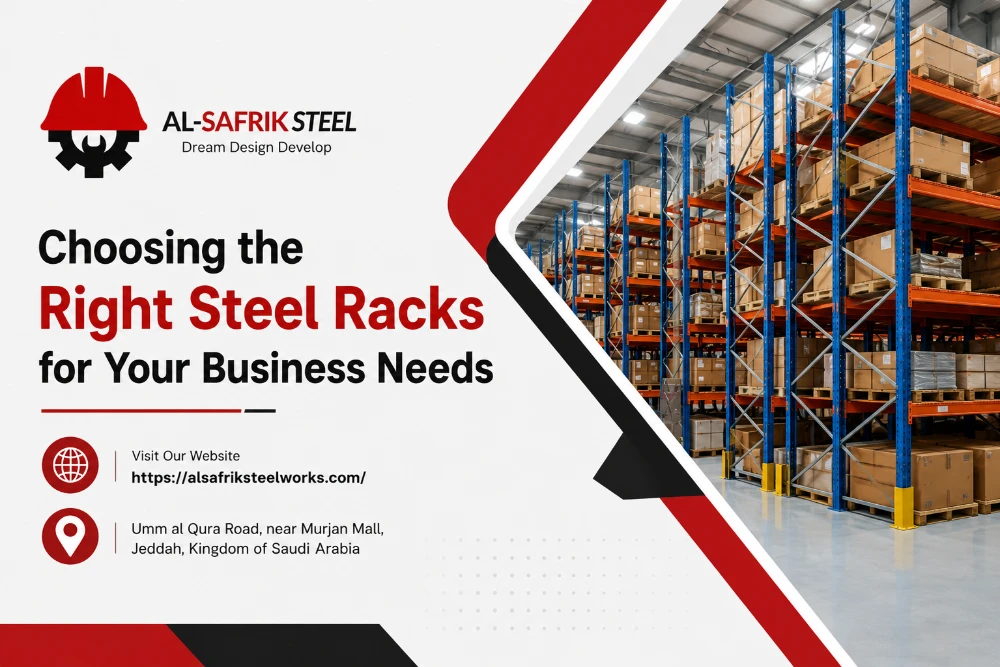
Storage is one of those operational areas that businesses tend to underestimate until it becomes a problem. When warehouse space runs out, inventory goes missing because nothing has a defined location, and forklifts cannot move efficiently because pallet stacks are blocking aisles. It is the time when the cost of inadequate storage infrastructure becomes very visible, very quickly.
For businesses across Saudi Arabia, from the vast logistics facilities that serve Riyadh’s distribution networks to the industrial warehouses concentrated in Dammam’s port zone, steel racks are the foundational storage solution that keeps operations running efficiently. In the manufacturing operations spread across Jubail and Yanbu, steel racks are the foundational storage solution that keeps operations running efficiently. But choosing the wrong racking system for your specific operation creates its own set of problems: wasted space, inefficient product flow, safety risks, and the eventual cost of replacing a system that was never quite right for the job.
Why Steel Racks Are the Storage Foundation of Modern Business Operations?
Before examining the different types of metal shelving and racking systems, it is worth understanding why steel is the material of choice for commercial storage infrastructure, particularly in Saudi Arabia’s demanding operating environment.
Industrial steel racks offer a combination of load capacity, dimensional stability, and longevity that alternative materials cannot match at commercial scale. In warehouses where pallets weighing several hundred kilograms must be stored at multiple levels, the structural integrity of heavy-duty steel shelving is non-negotiable. In the extreme ambient temperatures experienced across the Kingdom, particularly in industrial zones where interior spaces can reach significant heat levels. The steel maintains its structural properties without the deformation or degradation that affects polymer and composite alternatives.
Steel is also highly adaptable. Most modern pallet racking systems and industrial shelving solutions are designed with adjustable beam heights and modular configurations, allowing the storage system to evolve as business needs change. It will add bays, reconfigure layouts, or increase height capacity without requiring a complete replacement of the existing structure.
Understanding the Main Types of Steel Racks Available
Selective Pallet Racking — The Most Widely Used Industrial Storage System
It is the most common steel rack system found in warehouses and distribution centres across Saudi Arabia and globally. The configuration is straightforward, where upright frames support horizontal beams at adjustable heights, with pallets stored on the beams in single-deep rows accessible from the main aisle.
The defining characteristic of selective racking is direct access to every pallet position without moving other stock. This makes it the preferred system for operations managing a wide variety of SKUs, frequent stock rotation, and FIFO (first in, first out) inventory management requirements.
Key advantages of selective pallet rack systems include:
- Full access to every individual pallet location at any time
- Simple forklift operation with standard reach or counterbalance trucks
- Straightforward reconfiguration as product mix or storage requirements change
- Compatibility with most standard pallet sizes and weights
- Lower cost per pallet position compared to more complex racking configurations
For Riyadh distribution centers handling fast-moving consumer goods, and for Jeddah import warehouses managing diverse product lines, selective racking consistently represents the most practical starting point for pallet storage.
Drive-In and Drive-Through Racking — Maximum Storage Density
When floor space is the primary constraint and storage density matters more than individual pallet accessibility, drive-in racking systems offer a fundamentally different approach. Rather than storing pallets in accessible single-deep rows, drive-in racking creates deep lanes where pallets are stored multiple positions deep on continuous rails. The forklifts drive into the lane itself to place or retrieve stock.
Drive-in rack systems use a LIFO (last in, first out) inventory flow, meaning the most recently stored pallet in each lane is the first one retrieved. This makes them well-suited to operations that store large quantities of the same product, such as seasonal goods, raw material buffers, or products where first-in, first-out rotation is not a commercial priority.
Drive-through racking extends this concept by providing access from both ends of the storage lane, enabling FIFO product flow through the system and adding flexibility while retaining the density advantage.
These high-density storage rack configurations are particularly relevant for cold store operations, bulk commodity warehouses, and manufacturing facilities in Dammam and Jubail where large quantities of raw materials need to be stored in limited footprints.
Push-Back Racking — Combining Density With Selectivity
These racking systems represent a middle ground between selective access and high-density storage. Pallets are stored on inclined rails or carts that allow each new pallet placed at the front of a lane to push the previous one back deeper into the structure. When a pallet is removed, the remaining stock automatically rolls forward to the picking face.
The configuration allows two to six pallets of depth per lane while maintaining a single access point per lane at the aisle face. This means fewer aisles are needed to access the same number of pallet positions compared to selective racking.
Push-back rack systems are well-suited to:
- Operations with moderate SKU counts but multiple pallets per SKU
- Environments where forklift access from both ends of a lane is not practical
- Facilities looking to increase storage density without committing to a pure LIFO system
- Warehouses in Riyadh and Jeddah where real estate costs make every square meter of floor space commercially significant
Cantilever Racking — The Right Solution for Long or Irregular Loads
Not everything that needs to be stored fits neatly onto a standard pallet. Timber, steel sections, pipes, Aluminium profiles, furniture components, and building materials all present storage challenges that standard pallet rack systems are not designed to handle.
Cantilever racking solves this problem with a configuration built specifically for long, oversized, or irregularly shaped loads. Rather than horizontal beams connecting two upright frames, cantilever systems use a central vertical column with arms projecting outward at intervals — creating open storage levels with no front-column obstruction that would interfere with loading long items from the side.
Cantilever storage systems are essential for:
- Steel stockists and metal distribution businesses
- Timber merchants and building material suppliers
- Furniture manufacturers and retailers
- Pipe and tube storage in industrial facilities across Yanbu and Jubail’s petrochemical supply chain
The arms on cantilever systems are typically adjustable in height, and the load capacity per arm can be specified to match the weight of the materials being stored, ranging from lightweight aluminium profiles to heavy steel sections.
Mezzanine Racking — Creating Additional Floor Space Vertically
For businesses operating in facilities where floor area is genuinely limited but building height allows vertical expansion, mezzanine racking systems effectively double or triple the usable floor space within the existing footprint.
A mezzanine storage structure is a raised platform supported by a steel frame, creating an additional floor level within the warehouse or workshop. The space below the mezzanine remains fully usable for pallet storage, vehicle movement, or production activity. At the same time, the upper level provides additional storage, office, or workspace capacity.
In Saudi Arabia’s urban industrial areas, where land costs in locations like Riyadh’s industrial districts and Jeddah’s commercial zones make facility expansion expensive, mezzanine systems deliver significant increases in storage capacity without the cost and disruption of relocating to larger premises.
Mobile Racking Systems — Maximum Use of Every Square Metre
Also referred to as compact rolling shelving or movable aisle racking, they take a fundamentally different approach to storage density. Rather than maintaining fixed permanent aisles between every row of racking, mobile systems mount the racking rows on motorized carriages that run on floor tracks. A single working aisle is created wherever needed by moving the adjacent rack rows apart, and then closed again when access is no longer required.
This approach can increase storage capacity within the same floor footprint by 80 to 100 percent compared to conventional selective racking with fixed aisles. This makes it the most space-efficient steel shelving solution available for facilities where floor area is the critical constraint.
Mobile storage systems are used in:
- Archive and document management facilities
- Cold stores and temperature-controlled warehouses
- Pharmaceutical and medical supply storage
- High-value goods warehouses requiring controlled access
- Government and institutional storage facilities
Medium Duty and Light Duty Shelving — For Smaller Items and Retail Storage
Not every storage requirement involves pallets or heavy industrial loads. Medium-duty steel shelving and light-duty metal storage racks serve a different but equally important function: organizing smaller items, boxed goods, spare parts, tools, and retail merchandise in a structured, accessible way.
These steel shelving systems are widely used in:
- Retail stockrooms and back-of-house storage areas
- Auto parts and mechanical workshops
- Spare parts and maintenance stores in industrial facilities
- Pharmaceutical and medical supply storage rooms
- Small-to-medium warehouse operations managing boxed inventory
The adjustable shelf heights on standard steel shelving units allow the system to accommodate a wide variety of box sizes and product dimensions, making them versatile and long-lasting even as the product mix changes over time.
Key Factors to Consider When Choosing Steel Racks for Your Business
Selecting the right steel racking system for a Saudi Arabian operation requires careful consideration of several practical factors before any purchase decision is made:
Load requirements: understand the maximum weight per pallet, per shelf level, and per bay. Every industrial rack system carries a structural load rating that must match or exceed the actual loads it will carry, including appropriate safety margins.
Product characteristics: Are you storing standard pallets, long loads, small items, or a mix of inventory? Product shape, size, and weight distribution all influence which racking type is appropriate.
Inventory management approach: FIFO requirements favour selective or drive-through systems. LIFO operations can benefit from drive-in or push-back configurations. Random access requirements point toward selective racking.
Warehouse dimensions: Available floor area, clear height, column spacing, and door positions all affect which system fits and how much storage capacity can be achieved.
Forklift and handling equipment: The type of equipment available for loading and unloading the rack directly affects which configurations are practical. Narrow aisle racking requires specialist trucks. Drive-in systems need forklifts capable of operating within a confined lane.
Future flexibility requirements: Businesses that expect their product mix, volume, or operations to change significantly should prioritize modular systems that can be reconfigured without complete replacement.
Getting the Specification Right From the Start
The cost of selecting the wrong steel rack system in terms of inefficiency, rework, and eventual replacement consistently exceeds the cost of taking the time to specify correctly at the outset. Structural calculations, load certification, and compliance with applicable Saudi standards should be part of every significant racking installation, not an afterthought.
Al Safrik Steel supplies a comprehensive range of industrial steel racking and shelving solutions across Saudi Arabia — providing clients with product specifications, load certifications, and technical support to ensure the selected system is the right fit for each project’s operational requirements.
FAQs
What is the maximum load capacity of industrial steel racks?
Load capacity varies by system, with light-duty shelving handling up to 200kg per shelf. At the same time, heavy-duty pallet racking can support several tonnes per level.
Can steel racking systems be reconfigured after installation?
Yes, most modular steel rack systems have adjustable beam heights. They can be expanded, reduced, or reorganized as your storage needs change.
What type of steel rack is best for a small warehouse?
Selective pallet racking is ideal for small warehouses, offering direct access to every pallet position without complex forklift maneuvering.
Are steel racks suitable for outdoor storage in Saudi Arabia’s climate?
Yes, when specified with appropriate hot-dip galvanizing or powder coating, steel storage racks perform reliably in the Gulf region’s heat and humidity.
How long do industrial steel shelving systems typically last?
With proper installation and load management, quality steel racking systems last 15 to 25 years in standard commercial and industrial environments.

Recent Comments